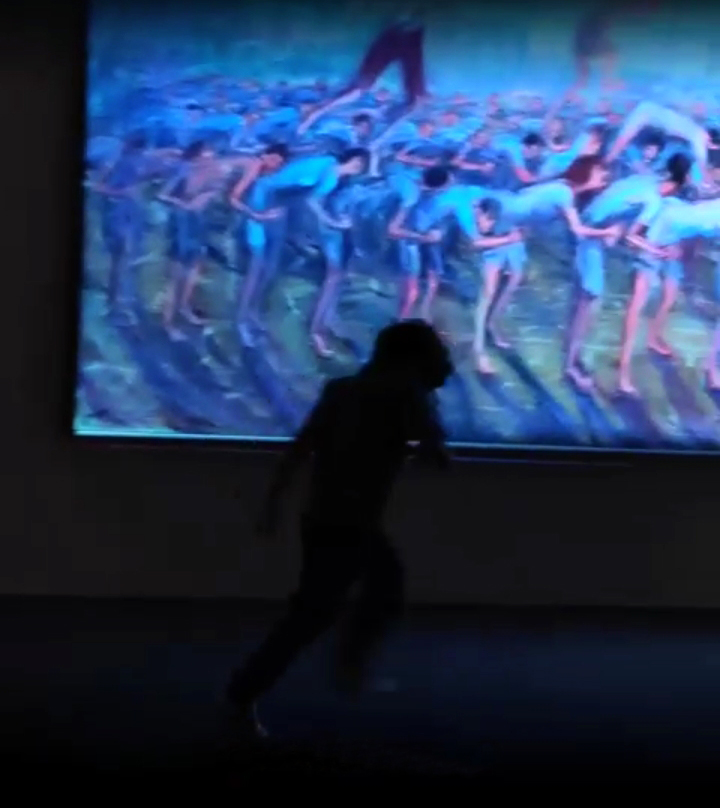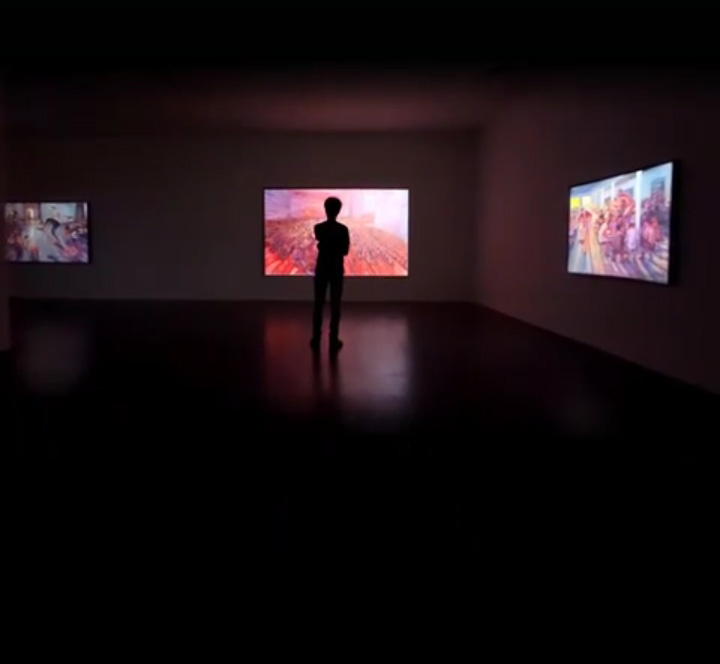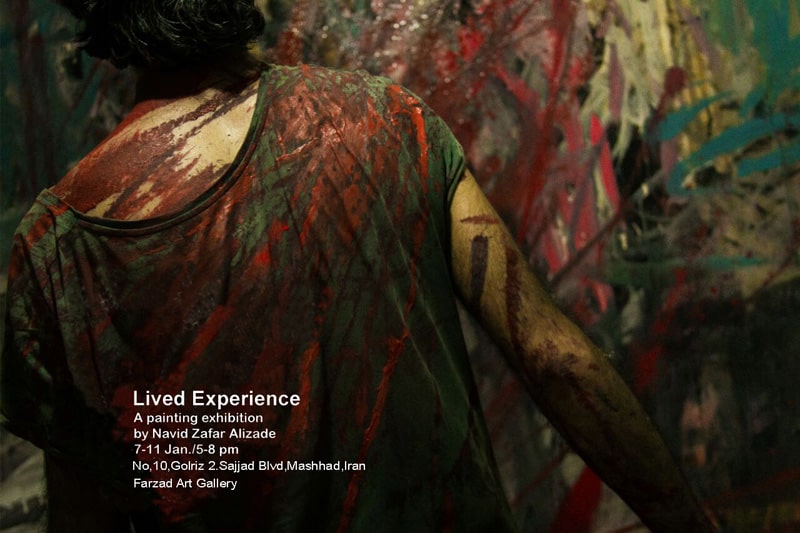
lived Experience, Farzad Gallery, Mashhad, Iran, 2016

Untitled, Elahe Gallery, Tehran, Iran, 2018
I close my eyes in order to see.
– Paul Gauguin
After a painful accident which led to eyesight disorder over a period of time. Navid Zafaralizadeh, awashed in a low morale of gloom, stress and deep concern about living. felt a great need for the act of painting. The present exhibition is the outcome of this period of the artist’s life: eerie, dreadful and rather satirical tableaus which seem to have taken shape out of an intention to escape a vexing situation, not to create something new. compositions in which boldness can be seen and felt in a painterly act. an act originated in the depths of the painter’s existence and way of seeing.
Zafaralizadeh has perceived the significance of his inner nature as an independent world with its own structure and order. He draws inspiration from the depth of his interiority. In this working context, the staged situation of color. line and, to some extent. space becomes unstable. in a way that it becomes visible to the viewer in a subjective/objective conjunction.
Far from oppressive pre-established models of painting. Zafaralizadehhas, in the course of his work as a diligent painter, reached a significant phase: attending to the intuitive mechanisms of his fluid inner world more than ever.
October 2018
Parviz Heidarzadeh


How It Took Shape, Radin Art Gallery, Mashhad, Iran, 2020
How It Took Shape?!
The present series is a selection of works created from 2017 to 2019.
This period represents an unconscious externalizing which emerged during my past ten years of working. Prior to that, my dreams and memories were the subjects of my paintings. Gradually, the course of work and the struggle between dream and reality brought me to a point after which my encounter with the subject is no longer predetermined. In this period I tried to let my subject, content, and sensibilities to take shape out of the unconscious which incessantly transfigures its purpose and makes my transformation in the course of the work inevitable.
By committing myself to the forces of the unconscious, my approach to the work changes from one angle to the other. This goes on to a point where the picture’s elements remain fixed in the disorder. Usually this happens when my consciousness judges the picture and consents to its form.
I do not intend to get rapt in endless intangible subjective theorizations. Rather, as a painter, I’ve objectified my emotions and intuitive perceptions through color. Ultimately, I’ve sought to resolve this in painting itself. In the present exhibition. I’ve tried to show the course of what I described above.
January 2020
Navid Zafar Alizadeh
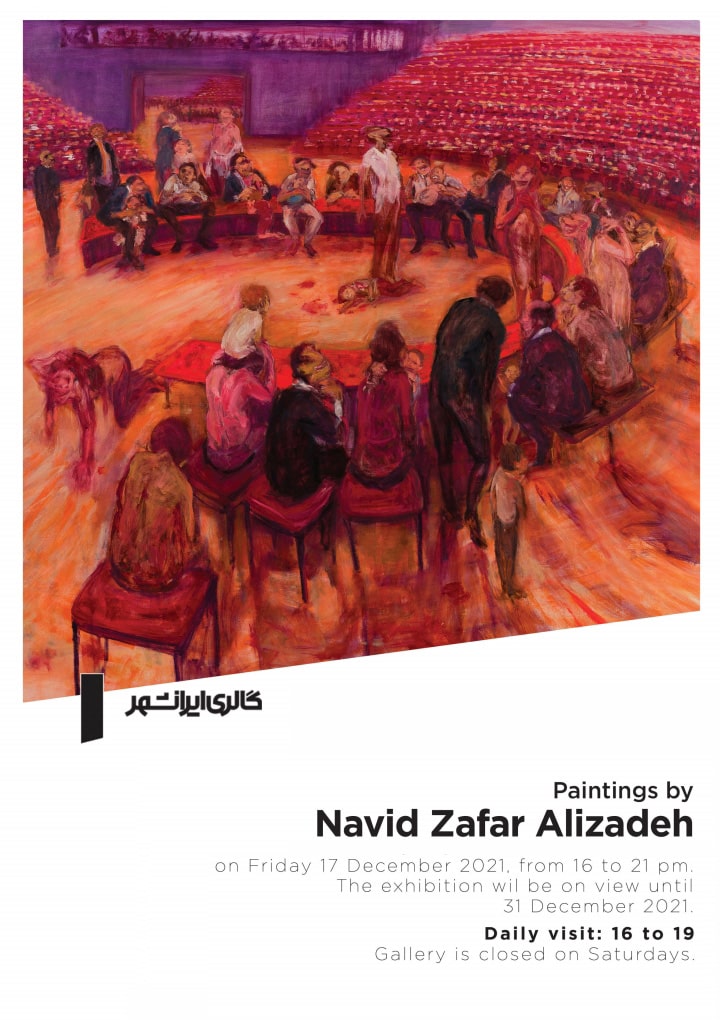
Funny Games, Iranshahr Art Gallery, Tehran, Iran, 2021
Funny Games
A reflection on the paintings of Navid Zafar
Mohammad Parvizi
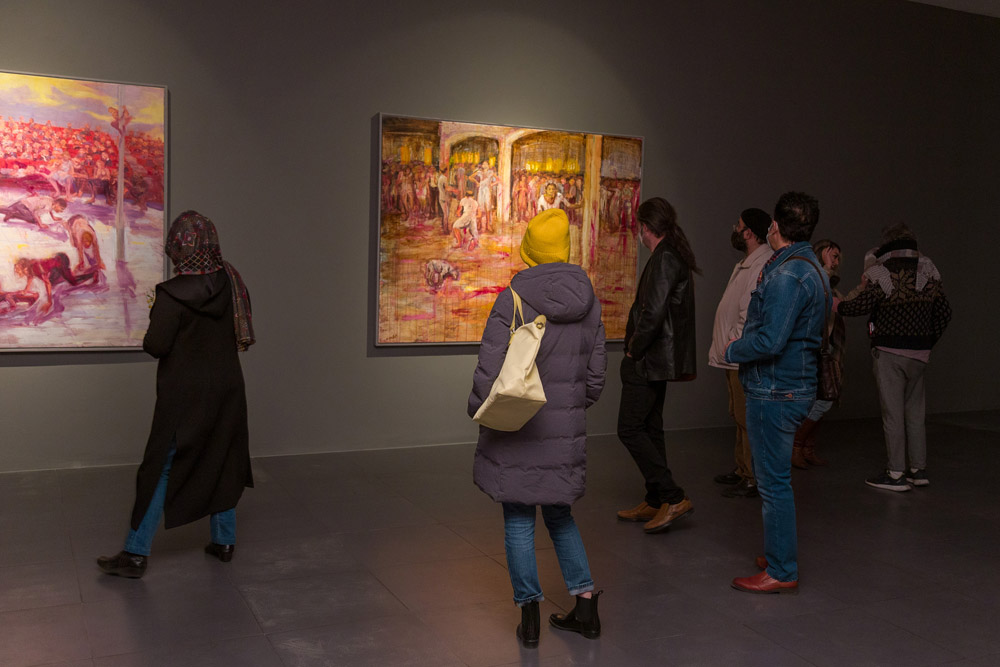
“Getting to act” is the theme of the works of Navid Zafar, that is, staging the “play” (through action) as such. The tragic, bitter aspect of his work is the theatricality of these plays. In a sense, it is staging and getting everything to act. As such, playing” up to insanity, mangling each other in the most ghastly way, or playing with children to the point of their being slaughtered. In other words, creating an unrestrained mob, or in an accumulation of idle distorted figures, among faces reminiscent of the “maschere of commedia dell’Arte, their only difference being that there is no mask on these faces; rather, what has distorted them is an all-over metamorphosis. Individuals with distorted mouths laughing boisterously while doing the most outrageous deeds, not only in public, but in the form of a dramatic work on stage and, finally, an audience of the same type, sitting indifferently, looking at the play of players whose hands are dirty with blood, or laughing and making faces… These theatrical aspects have become a characteristic of Navid Zafar’s paintings. In other words, he has not only been able to use them as subject matter but has benefitted greatly from the dramatic workings of theater in advancing his own work. Why should this experience of painting be regarded as “staging”? Having in mind that the definition of the theatrical stage draws its meaning from the crowd of living individuals on it, what is the particularity and significance of the painted scenes with the theatrical stage? Or, what does it mean (here) for the painting to become dramatic? In order to respond, one should know that the painter makes his subject matter theatrical in order to highlight the dramatic element of disasters. In a sense, he is not content to just display or paint mishaps.
more…
Damdameh, Iranshahr Art Gallery, Tehran, Iran, 2023
Damdameh
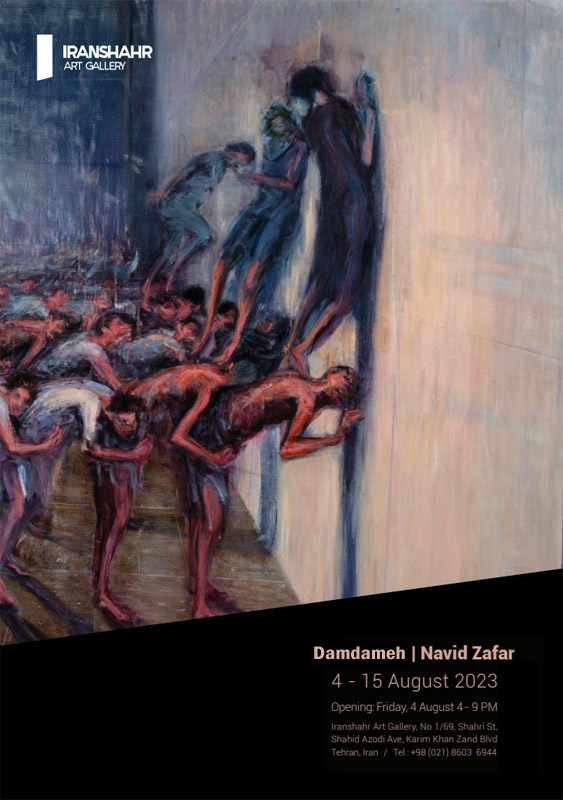
It was twilight. The news came that the soul robber has returned, the madmen, as before, woke up in whispers. They still chattered in each other’s ears darkly and rejected, which turned into a sad song. There was nothing left for the end of the night, the bell rang, it was almost “damdameh”(dawn and deception)